The Sun, Earth, and Moon — Motions and Effects
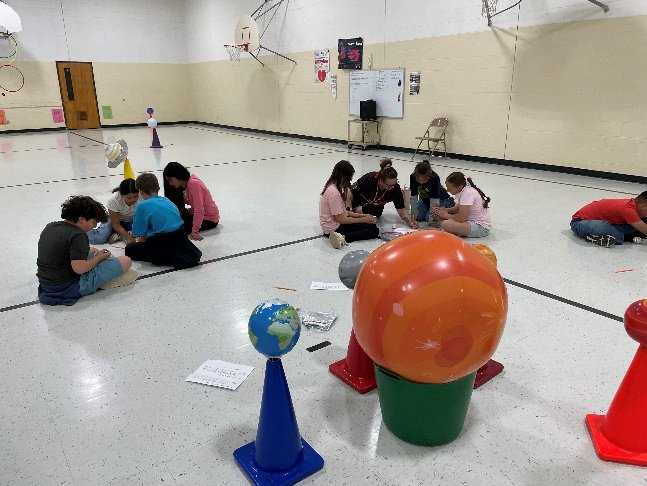
Students will review the types of objects the Sun, Moon, and Earth are and their characteristics, as needed for age group. They will then create kinesthetic models and use other hands-on models to understand the motions of the Earth, Moon and Sun. They will make connections about how those motions affect the way we experience day, night, a year, and changes in the Moon. Concepts such as what a model is, creating models and making observations will be used heavily. The teacher will pick one or both of the following add-on options.
Phases of the Moon: Students will explore why we see the Moon in different shapes, called phases, and the reason that the Moon is visible at different times using various Moon modeling activities. The phases of the moon are commonly misunderstood; our hands-on activities and discussions help dispel any misconceptions.
Seasons: Recognizing the seasons is one of the earliest forms of making scientific observations to recognize patterns taught in school, however, understanding what causes the seasons is riddled with misconceptions. In this program, students not only get an accurate visual demonstration of the Earth’s tilt and movement around the Sun using our seasons exhibit, but they also use a hands-on activity to conduct their own exploration of how the Earth’s tilt affects the amount of sunlight reaching different parts of the Earth at different times of the year.
Solar System Scale Study
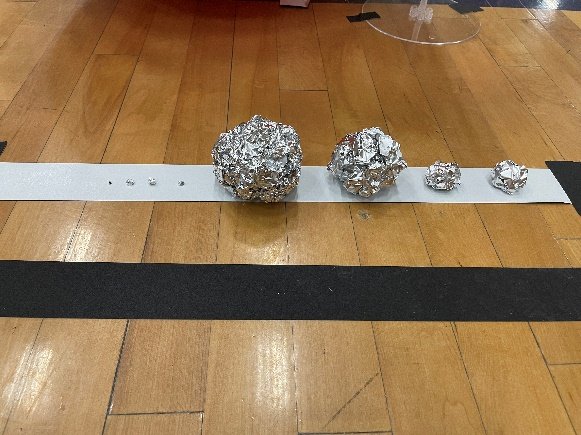
This program engages students in creating two different models of the solar system. The first takes your students outside or to the gym to create a scale-distance model, exploring the distances of the planets from the Sun. For the second model, students use sheets of aluminum foil to create a scaled solar system based on size and density. With a half or full day program, students will also have the opportunity to observe the Sun using solar telescopes.
Solar System Tour: The MESO educator will use an interactive, real-time data software to tour the planets of the solar system, providing interesting information about the Sun, planets, and moons as well as current planetary exploration missions.
Milky Way Scale (grades 5-8): Space is enormous and surprisingly empty. In this activity students consider the galaxy scaled to chia seed-sized “stars”. They use estimation and team work to visualize the number of stars in the Milky Way and are guided in calculating how far away the nearest chia seed-sized star would be from our chia seed-sized Sun.
Make Your Own Clay Asteroid
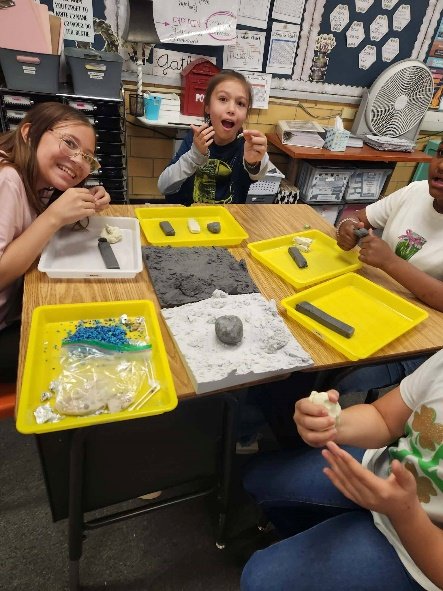
What is an asteroid and are there different kinds? During this program students will gain a basic understanding of asteroids — what they are, what they are made of, and where they are located in space — by studying images and 3D printed models. Older students will be introduced to the categories of asteroids that scientists use and why it is important to study them. They will then use clay, sand, rocks, and metals to create their own asteroid model. Interested students will present their model to the class and explain what materials they used and why.
Want MESO at your school? Contact Us!
Questions? Contact us at info@nssti.org.