Friction, Newton’s Laws, and Collisions
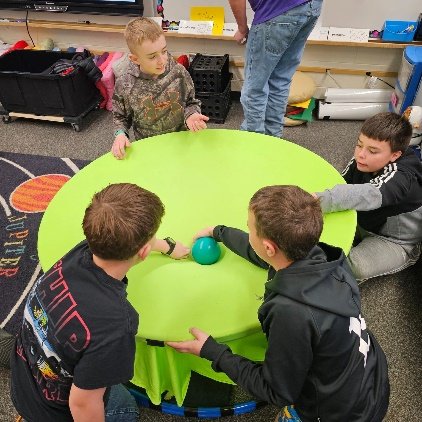
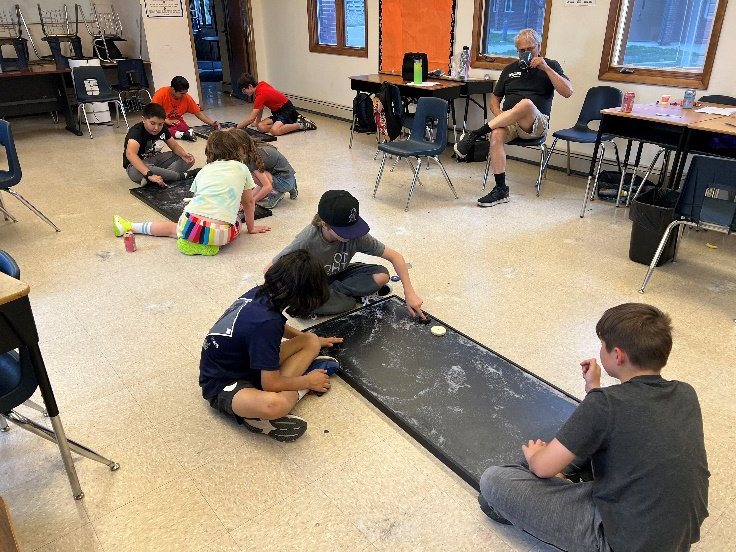
Using shuffleboard-like interactives, students discover how friction works and its importance, test Newton’s Laws in conceptual ways, witness how energy is transferred in collisions, and build observation and comparison skills. Adjusted based on grade level, students also investigate rotation in collisions and how that, as well as conservation of angular momentum, led to the formation of our solar system and the rotation and orbital directions of the planets.
Gravity Interactive Program
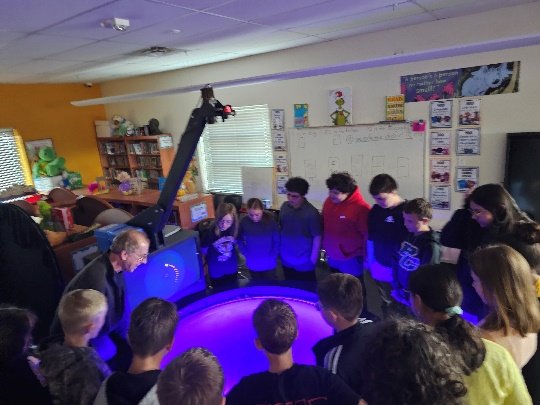
This program is easily adjusted for age group. It engages students using a dynamic gravity well, marbles, and weighted balls to model orbits in a planetary system. Younger ages focus on the basics of gravity, the predictability of orbits, and making observations. Upper ages cover the basics but also discuss in more detail the difference between Newton’s views of gravity versus Einstein’s Theory of General Relativity as well as concepts such as escape velocity, common center of mass, black holes, and finding the mass of stars. For half day or full day programs, this can include our large gravity demonstrator exhibit.
Want MESO at your school? Contact Us!
Questions? Contact us at info@nssti.org.