Introduction to Optics and Telescopes
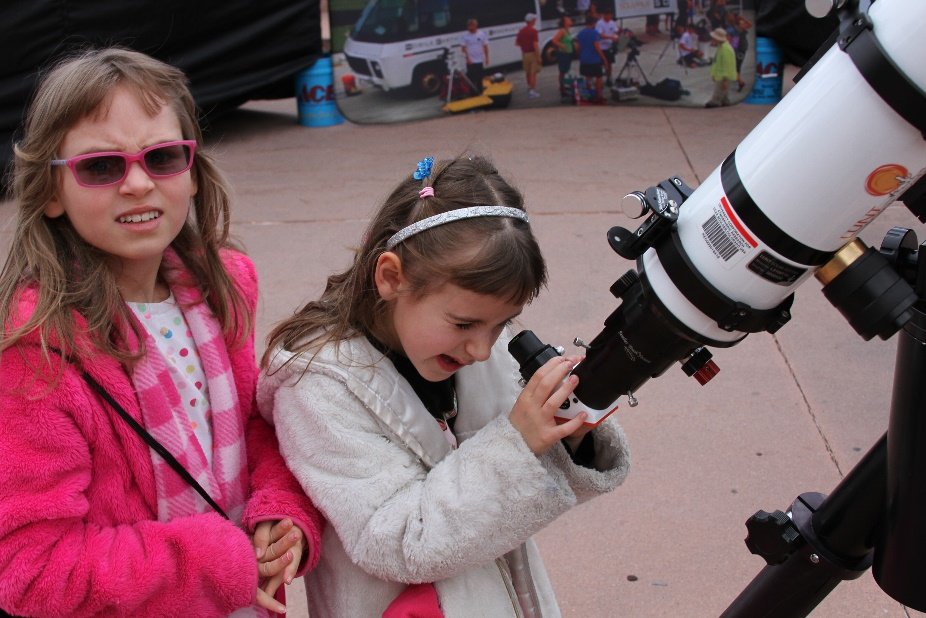
Students explore how telescopes help astronomers observe distant objects. They will use light boxes and lenses to investigate how pinholes and lenses of various sizes impact their observations of a lightbulb filament. Concepts such as clarity, magnification, focal length, and inverted images are observed and discussed. With Half or Full Day programs, students then use solar telescopes to observe the Sun.
Characteristics of Light — Spectroscopy, Energy, and Temperature
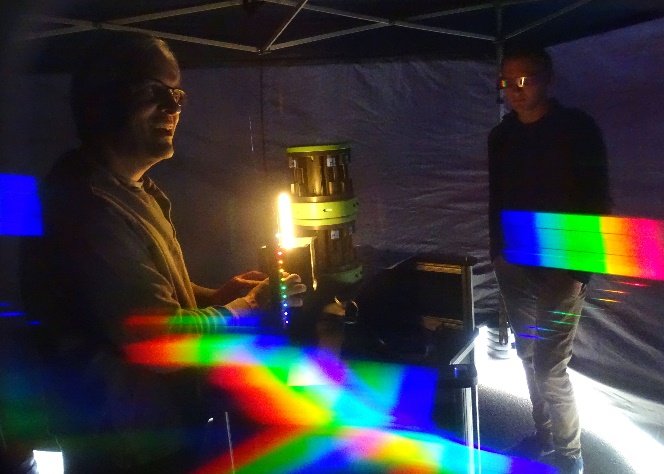
Students first consider how and why we see visible light emitted and the difference in temperatures that cause the differences in color by experimenting with a dimmable lightbulb and a diffraction grating. Red, green, and blue spot lights are used to demonstrate how colors in the form of light mix. Students will also use the diffraction grating to observe the emission spectra of various different gases. Through these activities students are introduced to the electromagnetic spectrum followed by discovering that there are types of light that are not visible to the unaided eye. With Half or Full Day programs, they investigate this further with an IR camera exhibit.
Build IR Emission Detector: Students wire together a solar cell and speaker to create an IR emission detector that emits sound when IR light is detected.
Characteristics of Light — Exploring Light for Young Learners
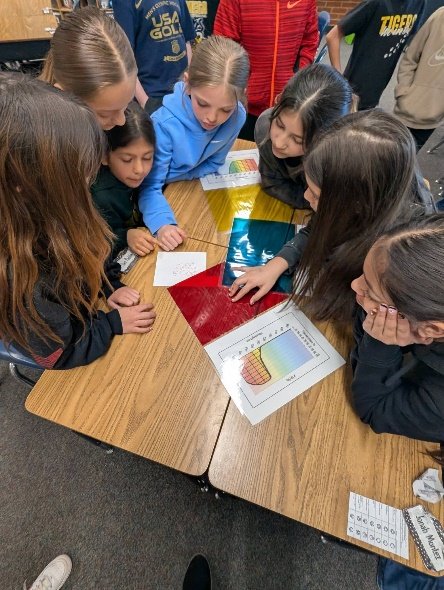
Young students learn how a light bulb makes light that we can see with our eyes and why that is different from how light is reflected off of surfaces. They will learn that white light is made of all the colors in a rainbow using a diffraction grating and how three colors of light combine to make other colors. Students will then get to “paint” with light using phosphorescent light boards.
Want MESO at your school? Contact Us!
Questions? Contact us at info@nssti.org.