Pipette Rockets
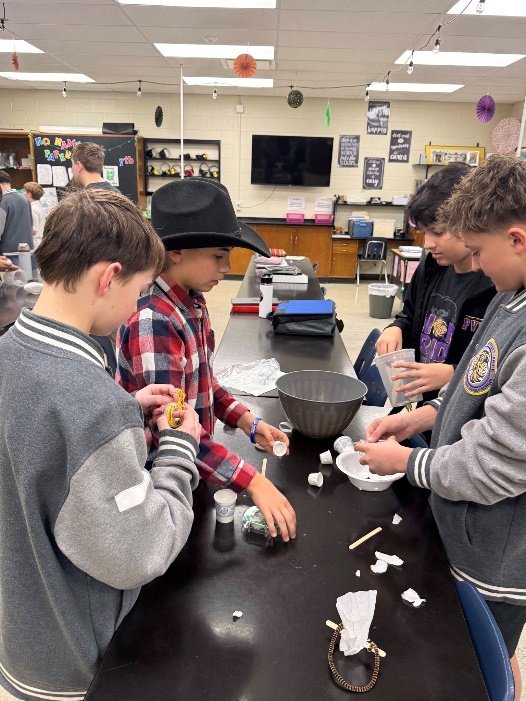
The first step to exploring space is leaving the Earth, which takes an incredible amount of energy. In this program, students combine the concepts of chemistry and physics to understand how rockets are propelled by first creating fuel for a pipette rocket and then launching their rocket across the room. Concepts such as balancing chemical equations, chemical reactions, thrust, energy transfer, and Newton’s 3rd law are emphasized. A large lab-like space with access to sinks is necessary for this program.
LIDAR Lab — Surface Mapping Challenge
The surfaces of planets and other solar system bodies are often mapped using Light Detection and Ranging (LIDAR) technology. In this hands-on lab, students explore how light travels and is reflected off of surfaces, apply that to the mathematical concept of Distance = Rate x Time, and conduct their own laser measurement and mapping project. The students make observations, record data, and create their own map of a 3D structure.
Asteroid Sample Collection Engineering Project
This more advanced lesson challenges students to use the Engineering Design Process to design, build, test, and redesign an asteroid sample collection device similar to that used on the OSIRIS-REx mission to asteroid Bennu. Students will be introduced to the mission, the parameters, and the generalized method that engineers and scientists used for the real spacecraft, but must use collaboration, critical thinking, and problem solving to optimize their design within the parameters for collecting as much asteroid material as possible. Students will be asked to consider the scientific benefit of collecting an asteroid sample and also introduced to the findings by scientists from the sample that OSIRIS-REx successfully returned to Earth.
OSIRIS-REx/APEX Science: Though an overview of the OSIRIS missions will be given for the engineering project, this add-on includes a more in-depth look at the other instruments on the OSIRIS spacecraft, such as infrared cameras, LIDAR detectors, and spectrometers. Students will engage in introductory hands-on experiences with those types of technology.
Communicating with Satellites
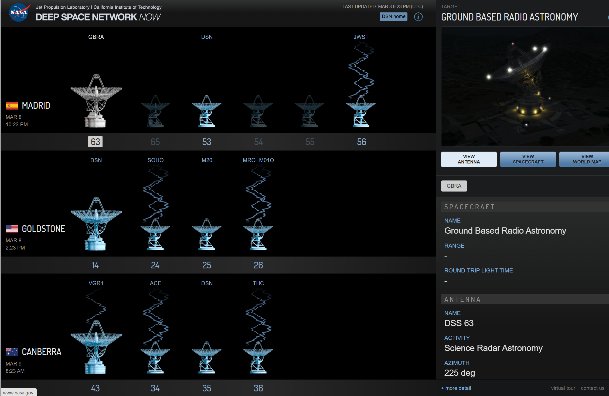
It is not commonly considered how we send commands and receive information and data from spacecraft. This program introduces the physics, technology, and computer science that makes it possible. Students will learn about radio waves and the Deep Space Network of radio antennas that send and receive signals using the real time NASA Eyes on the DSN software. They will then create a message in a binary code made of beads and decode bitmap images. More advanced students will be introduced to the difference in base 10 and base 2 code and work as a class to decode a real NASA image.
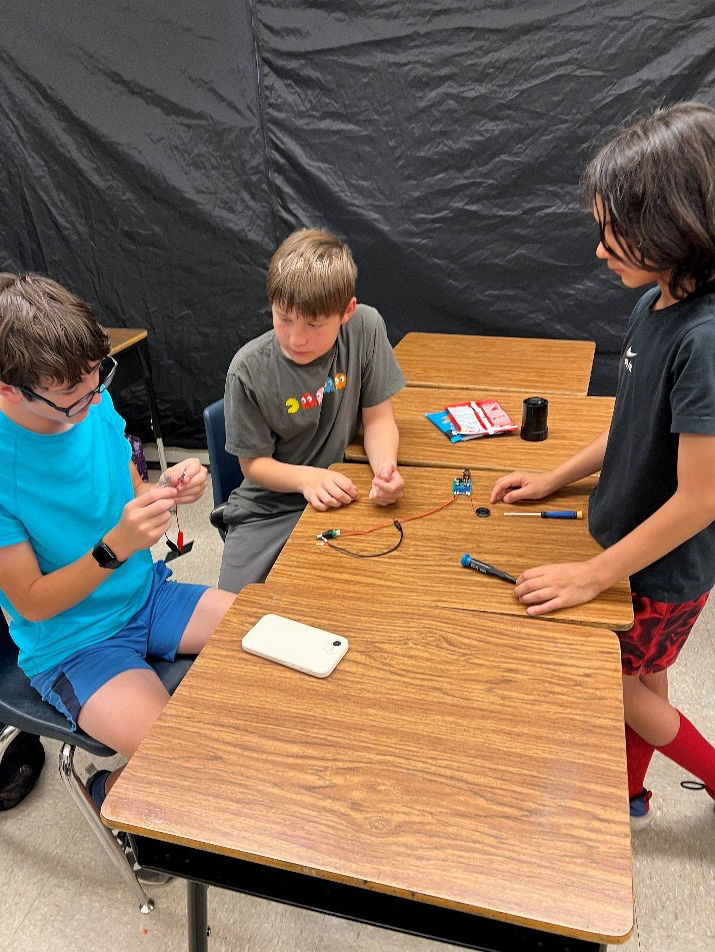
Build IR Emission Detector: Students wire together a solar cell and speaker to create an IR emission detector that emits sound when IR light from a remote control is detected. Space communication using IR lasers to achieve faster transmission rates is currently being tested by multiple missions. Students will be introduced to this new and innovative technology.
Want MESO at your school? Contact Us!
Questions? Contact us at info@nssti.org.